For years, creative professionals have relied on AI to generate text, edit images, create videos, summarize meetings, or brainstorm ideas. Those capabilities helped teams work faster, but they still required constant supervision. Every prompt, every revision, and every decision came from a human sitting behind the keyboard.
That model is changing.
Today's best AI agents can take ownership of complete workflows. Give them an objective, provide the necessary context, and they can break a project into smaller tasks, complete them in sequence, monitor progress, identify problems, and return only the parts that genuinely require human judgment.
That is a meaningful change for creative teams.
Marketing departments, agencies, content studios, ecommerce brands, and in house design teams are producing more assets than ever before. A single campaign can require dozens of social posts, multiple video formats, landing pages, ad creatives, email sequences, product visuals, blog articles, and localized versions for different markets.
Managing that volume manually has become increasingly difficult.
Recent industry research reflects the growing business impact of autonomous systems. Among senior executives already working with AI agents, 66 percent report measurable productivity gains. More than half also report lower operational costs, faster decision making, and noticeable improvements in customer experience.
Creative departments are beginning to see similar results.
Many repetitive production tasks can now move through agentic AI workflow automation without constant human intervention. Teams spend less time resizing assets, rewriting copy for different channels, organizing files, reviewing repetitive edits, or coordinating production steps. That leaves more time for strategic planning, creative direction, storytelling, and brand development.
The conversation has evolved considerably over the past two years.
Companies are no longer asking if AI belongs inside creative operations. Most teams have already answered that question. The focus today is selecting platforms that improve quality while reducing repetitive work.
That is an important difference.
Some tools generate content quickly but introduce inconsistency. Others automate small tasks but struggle once projects become more complex. The strongest enterprise AI agent platforms combine automation with context, allowing teams to scale output without sacrificing creative standards.
Throughout this ranking, you'll see products that approach the problem from different angles.
Some specialize in content generation.
Others focus on video production.
Some coordinate work across multiple departments.
Others function as a no code AI agent builder, allowing organizations to create custom automations without relying on developers.
The common thread is simple.
Every platform here helps creative professionals spend less time managing production and more time producing work that people remember.
Why AI Agents Feel Different From Traditional AI Tools
One of the biggest sources of confusion today comes from the language surrounding artificial intelligence.
Companies often describe almost every AI powered feature as an "AI agent," even when it behaves like a standard chatbot.
Understanding the difference helps explain why businesses are investing so heavily in autonomous systems.
This also answers one of the most common questions people ask today:
What are AI agents and how are they different from regular AI chatbots?
The simplest way to think about it is this.
Traditional AI tools respond.
AI agents execute.
Imagine you're launching a new product campaign.
With a traditional AI writing assistant, you would open the application, ask it to write a blog post, review the output, edit sections yourself, request revisions, copy the finished content somewhere else, then move on to creating social media posts.
Every step depends on you.
An autonomous AI agent approaches the same project very differently.
After receiving your objective, it can create the campaign brief, draft multiple content formats, prepare platform specific versions, resize accompanying visuals, organize production files, schedule approval workflows, and notify team members once assets are ready.
Human involvement still matters.
Creative direction, messaging, brand positioning, and final approval remain human responsibilities.
The repetitive coordination work becomes dramatically smaller.
That is why many organizations now see AI agent use cases for business extending far beyond content generation.
Creative teams are applying AI agents across every stage of production.
Some examples include:
• Campaign planning
An AI agent can gather research, analyze previous campaign performance, summarize competitor activity, recommend creative angles, and prepare a campaign brief before the first planning meeting even begins.
• Content production
Instead of creating one blog post or one advertisement at a time, AI agents can coordinate dozens of assets across multiple channels while maintaining consistent messaging and branding.
• Design adaptation
One approved creative concept often needs twenty different versions across social platforms, display advertising, websites, email headers, presentations, and ecommerce listings. AI agents can automate much of that repetitive production work.
• Project coordination
Creative work rarely happens inside one application. Designers, writers, marketers, legal reviewers, and stakeholders all contribute throughout production. AI agents can organize approvals, monitor deadlines, identify bottlenecks, and remind contributors when action is required.
• Performance optimization
After campaigns launch, AI agents continue working. They monitor engagement metrics, identify underperforming assets, suggest improvements, and prepare reports without waiting for manual analysis.
These examples illustrate why businesses increasingly view AI agents as digital teammates rather than standalone software. Each completed project makes future work faster and more consistent. For creative organizations producing hundreds or even thousands of assets each month, those cumulative gains become substantial over time.
How AI Use Has Changed Over the Last Few Years
Only a few years ago, most creative teams treated AI as an experiment.
Writers used it to overcome writer's block. Designers generated concept art to speed up brainstorming. Video editors removed backgrounds or generated subtitles. Marketing teams drafted social media captions before rewriting most of them manually.
Those early wins proved that AI could save time, but every task still depended on constant human direction.
Fast forward to 2026 and the conversation looks very different.
Creative organizations are building workflows where AI handles a chain of related tasks without someone manually triggering every step. One request can now lead to research, content creation, design adaptation, approval routing, performance tracking, and reporting.
That evolution explains why autonomous AI agents have become one of the fastest growing areas in artificial intelligence.
Companies are no longer searching for software that performs one isolated task. They want systems that understand goals, make logical decisions within defined boundaries, and continue working until the objective has been completed.
Research reflects that growing confidence.
Gartner estimates that agentic AI will autonomously make at least 15 percent of everyday business decisions by 2028. Creative industries are already moving in that direction. Recent surveys show that roughly 80 percent of creative professionals regularly use generative AI somewhere in their workflow, while around 40 percent rely on AI throughout almost every stage of content production.
Those numbers tell an interesting story.
Creative professionals are becoming more comfortable handing repetitive work to machines while keeping strategic thinking, storytelling, and creative direction firmly in human hands.
That combination produces better outcomes than trying to automate everything.
Think about a product launch.
Five years ago, a marketing manager would probably coordinate every moving piece manually. Writers created copy. Designers built graphics. Video editors produced promotional clips. Social media managers reformatted everything for each platform. Project managers chased approvals through endless email threads.
Today, one intelligent workflow can coordinate much of that production.
An AI agent can gather product information, generate campaign briefs, prepare multiple creative concepts, create channel specific copy, request visual assets, resize approved graphics, schedule review cycles, notify stakeholders, and monitor campaign performance after launch.
Human expertise remains at the center of every important decision.
The repetitive coordination work becomes significantly smaller.
That improvement matters because creative work has become dramatically more demanding.
One campaign rarely means one deliverable anymore.
Marketing teams often produce:
- Blog articles
- Landing pages
- Display advertisements
- Email campaigns
- LinkedIn posts
- Instagram content
- TikTok videos
- YouTube Shorts
- Product imagery
- Sales presentations
- Internal enablement documents
- Regional language variations
Each asset requires reviews, revisions, approvals, formatting, and publishing.
Managing those moving parts consumes enormous amounts of time.
That is where agentic AI workflow automation creates the biggest impact.
Rather than asking AI to complete one isolated task, organizations build connected workflows where one completed action automatically triggers the next.
A typical creative workflow might look something like this.
- A campaign brief enters the system.
- The AI researches competitors.
- It summarizes customer insights.
- It drafts messaging.
- Another agent creates social copy.
- Another prepares blog outlines.
- Another generates image concepts.
- Another resizes creative assets for every advertising platform.
- Another schedules review requests.
- Another tracks revisions until final approval.
From the team's perspective, the work keeps moving without constant supervision.
Creative professionals spend more time evaluating ideas and improving quality instead of coordinating dozens of repetitive administrative tasks.
That growing level of automation explains why many organizations have expanded their search beyond individual AI applications.
They are looking for complete ecosystems that combine content creation, project management, collaboration, automation, and brand governance under one roof.
As a result, interest has grown rapidly around several related categories, including:
- Enterprise AI agent platforms capable of supporting large marketing organizations with centralized governance and security.
- No code AI agent builder solutions that allow marketing teams to build custom workflows without relying on engineering resources.
- Specialized creative AI agents designed specifically for video production, visual design, copywriting, or campaign management.
Best AI Agents for Business Productivity and Workflow Automation in 2026
Creative teams have more choices than ever before.
Every month introduces another platform promising smarter automation, faster production, or completely autonomous creative workflows. Some genuinely reduce manual work across an organization. Others simply add another AI feature to existing software.
For this ranking, the emphasis goes beyond impressive demonstrations.
1. Pixara.ai

Many AI platforms solve one creative problem exceptionally well.
One might generate images, while another tool focuses on video and image creation part. Doesn’t that sound like a fuss to you?
People jump between multiple subscriptions, transfer files manually, keep track of different credit systems, and repeat prompts across several applications. That fragmented workflow slows production and creates unnecessary complexity.
Pixara.ai approaches the problem from a completely different direction. Rather than functioning as another standalone AI application, it serves as a unified creative workspace where multiple AI models and intelligent workflows operate together.
Instead of deciding which platform to open next, users concentrate on the creative outcome, while this program provides access to many of the industry's leading AI models from one dashboard.
That sense of diversity and flexibility becomes increasingly valuable as creative work grows more complex.
A campaign might begin with brainstorming inside Ara AI, continue with image generation, move into cinematic video production using models like Veo, Kling, or Sora, add professional voice narration, pass through video editing, and finish with export ready assets.
All of those stages happen without constantly switching between separate software ecosystems.
For organizations building larger creative operations, this creates a much smoother experience than stitching together half a dozen disconnected tools.
Our solution also aligns closely with what many businesses now expect from autonomous AI agents. Creative work rarely begins and ends with one prompt.
Projects evolve through multiple revisions, multiple asset types, multiple team members, and multiple publishing channels.
Pixara brings those creative stages together inside a single collaborative workspace, allowing teams to spend less time managing software and more time producing campaigns.
Another major strength is accessibility.
Many creative professionals are marketers, founders, ecommerce managers, educators, or agency account managers rather than AI engineers.
Pixara keeps advanced creative technology approachable without requiring technical expertise.
That makes it especially attractive for organizations looking for a practical no code AI agent builder style experience where sophisticated creative workflows remain accessible to non technical teams.
Why creative teams choose Pixara.ai
Before looking at the feature list, it helps to understand why so many growing teams gravitate toward an all in one creative platform.
Creative production rarely stops at generating one image or writing one paragraph.
Most campaigns require multiple asset formats, multiple revisions, and multiple publishing destinations.
Managing all of that across separate AI applications quickly becomes exhausting.
The online platform removes much of that friction, giving teams one place to create, edit, collaborate, and publish creative work while taking advantage of leading AI models under a single subscription.
Best for
Creative agencies, marketing departments, ecommerce brands, startups, educators, content creators, and enterprise marketing teams looking for an end to end AI powered creative workspace.
Key capabilities
- Ara AI creative assistant for planning and content generation.
- AI image creation powered by leading generation models.
- AI video generation with access to Veo, Kling, Sora, Seedance, and other premium models.
- Professional AI voice generation and audio production.
- Built in video editing environment.
- Product advertisement templates.
- Unified multi model creative workspace.
- Community driven prompt sharing and inspiration.
- Subscription plans designed for individuals through enterprise teams.
Pricing
Starter begins at $10 per month, Hobby at $25 per month, Pro at $60 per month, and Ultimate at $250 per month.
This digital solution delivers exceptional value for creative professionals who would otherwise pay for several separate AI subscriptions while still managing disconnected production workflows.
2. Jasper

When Jasper first entered the market, most people knew it as an AI writing assistant.
Marketers used it to speed up blog writing, advertising copy, product descriptions, and email campaigns. It quickly became one of the most recognizable names in AI assisted content creation because it solved a very practical problem. Producing high quality marketing copy at scale takes time, and most teams never seem to have enough of it.
Fast forward to 2026, and Jasper has grown far beyond content generation.
Today, the platform functions more like a coordinated marketing workspace powered by multiple AI agents that work together throughout the content lifecycle. Rather than asking AI to write one article or one advertisement, marketing teams can build repeatable workflows that carry projects from initial brief to finished campaign while maintaining brand consistency along the way.
That evolution has made Jasper one of the strongest enterprise AI agent platforms available for marketing organizations that produce large volumes of written content.
One of Jasper's biggest strengths lies in understanding that content creation is only one piece of a much larger marketing process.
Most campaigns begin with research.
They continue through planning, drafting, editing, approvals, optimization, publishing, and performance analysis.
Each stage generates information that can improve the next campaign.
Jasper connects many of those stages together.
Its underlying intelligence layer, Jasper IQ, gives AI agents access to company knowledge, brand guidelines, previous campaigns, customer information, messaging frameworks, and writing standards. Every new project benefits from that accumulated context.
That becomes especially valuable for organizations with multiple writers, agencies, freelancers, or regional marketing teams.
Without centralized guidance, content quality often varies from one person to another. Tone changes, messaging drifts, and brand language slowly becomes inconsistent across different channels.
Jasper helps reduce that problem.
Rather than depending on every writer to remember every brand guideline, the platform applies those standards throughout the workflow.
As organizations continue expanding their use of AI agent use cases for business, consistency has become just as valuable as speed.
Producing hundreds of articles every month serves little purpose if each one sounds like it came from a different company.
Jasper addresses that challenge remarkably well.
Why marketing teams continue choosing Jasper
Many AI writing platforms generate impressive first drafts.
Far fewer help organizations scale content production across dozens of employees while maintaining quality control.
That is where Jasper continues separating itself from many competitors.
For businesses publishing hundreds of marketing assets every month, centralized governance often becomes more valuable than raw writing speed.
Marketing directors gain greater confidence that campaigns align with company messaging.
Content managers spend less time correcting inconsistent language.
Writers can concentrate on improving ideas rather than memorizing lengthy brand documentation.
The result is a smoother editorial process from beginning to end.
Best for
Marketing departments, content teams, agencies, SaaS companies, and enterprise organizations that need to produce large volumes of written content while maintaining a consistent brand voice across multiple channels.
Key capabilities
Before choosing Jasper, it helps to understand where the platform delivers the greatest value.
Its strengths extend well beyond AI writing.
They center on coordinating large scale marketing operations.
Key capabilities include:
- More than 100 specialized AI agents built for different marketing tasks.
- Jasper IQ for centralized brand intelligence.
- Brand Voice to maintain consistent messaging.
- Content Pipelines that automate repeatable production workflows.
- Canvas workspace for collaborative editing.
- Marketing templates covering SEO, advertising, email, product marketing, and social media.
- Enterprise governance controls.
- Collaboration tools designed for distributed marketing teams.
Pricing
Jasper offers a seven day free trial.
Paid plans begin at $59 per seat each month, while Business plans use custom enterprise pricing based on organizational requirements.
Where Jasper fits among today's best AI agents
Jasper remains one of the strongest choices for organizations whose creative output revolves primarily around written communication.
If your team's daily work includes SEO content, newsletters, advertising campaigns, landing pages, email marketing, thought leadership, and product messaging, Jasper delivers one of the most mature ecosystems available today.
Teams looking for image generation, cinematic video production, or multimedia asset creation will likely pair Jasper with another creative platform.
That combination works well because each platform focuses on what it does best.
Jasper excels at intelligent marketing content operations.
Other platforms handle visual production.
Together, they create a highly efficient creative workflow.
How to Choose the Best AI Agent for Your Business: A Buyer's Guide
Choosing among today's AI platforms can feel overwhelming.
Nearly every vendor claims to offer autonomous workflows, intelligent agents, or enterprise automation. On paper, many products appear remarkably similar.
The reality becomes much clearer once you map software against your team's everyday work.
- A content marketing department has very different requirements from a video production agency.
- An ecommerce company produces thousands of product assets every month.
- A global enterprise manages approvals across multiple departments and regions.
- Each organization benefits from a different type of AI ecosystem.
Before investing in any platform, it helps to answer a few practical questions.
What kind of work consumes the most time?
The first step is identifying repetitive work rather than chasing the newest technology.
Some teams spend most of their week writing.
Others lose hours coordinating approvals.
Design teams often spend enormous amounts of time adapting one campaign into dozens of platform specific formats.
Finding your biggest bottleneck usually points toward the right software category.
Does your team need one specialist or an all in one platform?
Some platforms perform one task exceptionally well.
Others combine writing, image generation, video creation, voice production, editing, collaboration, and automation inside one environment.
If your creative team regularly switches between multiple subscriptions every day, consolidating those workflows can produce significant productivity gains.
How important is brand consistency?
For small businesses, occasional inconsistency may not create major problems.
Large organizations face a very different challenge.
Hundreds of employees producing thousands of assets can quickly dilute brand identity.
Platforms with centralized brand governance become increasingly valuable as organizations grow.
Can non technical employees build workflows?
One of the biggest developments in 2026 has been the rise of the best no code AI agent builders for non technical teams.
Marketing managers no longer want to wait for engineering support every time they need a new workflow.
Platforms that allow business users to create automations through visual interfaces dramatically reduce implementation time while encouraging experimentation across departments.
Will the platform grow alongside your business?
Creative operations rarely stay the same for long.
A startup producing twenty marketing assets each month may generate thousands within a few years.
Choosing software that supports future expansion often saves considerable migration work later.
Looking beyond today's requirements can prevent expensive platform changes as teams grow.
3. Adobe Firefly + GenStudio

Adobe has spent decades building software that creative professionals rely on every day.
Photoshop became the standard for image editing.
Illustrator transformed vector design.
Premiere Pro became a staple for video production.
After Effects helped define motion graphics.
When artificial intelligence began reshaping creative work, Adobe had one major advantage over many newer AI companies.
It already understood how creative teams work.
Professional designers rarely create content inside one application from start to finish. A marketing campaign moves through brainstorming, design, editing, approvals, revisions, localization, publishing, and performance analysis. Every stage involves different people, different assets, and different creative decisions.
Adobe built Firefly and GenStudio around that reality.
Rather than introducing another standalone AI generator, Adobe expanded its existing creative ecosystem with intelligent automation that fits naturally into established production pipelines.
For enterprise organizations, that makes adoption much easier.
Designers do not need to abandon familiar software.
Marketing teams do not need to rebuild their creative processes from scratch.
Creative work simply becomes faster.
Firefly brings commercial AI generation into professional design
One of the biggest concerns surrounding AI generated content has always been commercial safety.
Businesses investing millions into advertising campaigns need confidence that generated assets can be used professionally without introducing unnecessary legal uncertainty.
Adobe addressed that concern early.
Firefly is trained using Adobe Stock, openly licensed material, and public domain content, giving organizations greater confidence when creating commercial marketing assets.
That foundation has made Firefly particularly attractive for enterprise creative departments where compliance, licensing, and brand protection carry significant weight.
The platform now supports a broad range of creative formats.
- Teams can generate images.
- Create illustrations.
- Produce vector artwork.
- Generate audio.
- Create AI powered video.
- Expand existing designs.
- Modify backgrounds.
- Replace objects.
GenStudio connects creativity with marketing execution
Firefly focuses primarily on content creation.
GenStudio extends that work into campaign production.
Think of GenStudio as the operational layer that helps marketing organizations manage creative assets after they have been produced.
Campaign teams can generate multiple advertising variations.
- Prepare assets for different channels.
- Coordinate reviews.
- Maintain approval workflows.
- Apply brand governance.
- Track campaign performance.
All from within the broader Adobe environment.
For enterprise marketing organizations, that coordination reduces many of the delays that normally appear during campaign production.
Creative assets move through production with greater visibility while remaining aligned with established brand standards.
AI agents inside the Adobe ecosystem
Adobe has gradually expanded intelligent automation across Creative Cloud.
Natural language editing now appears throughout several applications.
A designer can describe an edit instead of manually completing dozens of individual steps.
- Video editors can remove distracting objects.
- Backgrounds can change automatically.
- Images expand beyond their original dimensions.
Campaign assets adapt for different publishing channels with far less manual effort.
Although Adobe rarely markets every capability as a standalone autonomous AI agent, many workflows now resemble modern agentic AI workflow automation.
Several connected AI systems work together across the creative lifecycle while allowing designers to remain in control of final creative decisions.
That balance works particularly well for enterprise environments where creative quality remains the highest priority.
Best for
Enterprise marketing departments, in house creative teams, agencies, global brands, and organizations already invested in the Adobe Creative Cloud ecosystem.
Key capabilities
Adobe's biggest strength comes from connecting intelligent automation with professional creative software that millions of designers already use every day.
Some of its most valuable capabilities include:
- Firefly image generation.
- AI video generation.
- Vector artwork creation.
- Audio generation.
- Commercially safe AI models.
- Firefly Custom Models for brand specific creative assets.
- Campaign asset generation.
- Channel specific content variations.
- Creative approval workflows.
- Brand governance.
- Performance insights.
- Deep integration across Creative Cloud.
Pricing
- Firefly plans begin at $9.99 per month for individual users.
GenStudio uses custom enterprise pricing based on organizational requirements.
Where Adobe Firefly and GenStudio fit among the best AI agents
Adobe's strength has never been producing the fastest demonstrations.
Its strength lies in helping large creative organizations produce professional work at scale.
Teams already working inside Creative Cloud gain intelligent automation without disrupting established workflows.
That combination makes Adobe one of the strongest enterprise AI agent platforms available for professional creative production.
4. Runway

Only a few years ago, AI generated video often looked experimental.
- Characters changed appearance between scenes.
- Movements appeared unnatural.
- Objects warped unexpectedly.
- Lighting shifted from one frame to another.
Many creators viewed AI video as an interesting technology demonstration rather than a serious production tool.
Runway helped change that perception.
Each generation of its video models has moved closer to professional quality, and the company's latest releases produce cinematic footage that many creators confidently use in commercial projects.
Today, Runway has become one of the most influential AI platforms for video creators, filmmakers, advertising agencies, and marketing teams producing high volumes of digital content.
For organizations investing heavily in video marketing, Runway delivers one of the strongest examples of AI agent use cases for business inside creative production.
Video production contains countless repetitive tasks
Creating great video involves much more than generating footage.
Marketing teams prepare different aspect ratios for YouTube, Instagram, TikTok, LinkedIn, and connected television advertising.
Many of those tasks consume hours without contributing much creative value.
Runway dramatically reduces that workload.
Its AI powered editing tools allow creators to describe many edits through natural language rather than manually completing each technical step.
That creates a much faster production process.
Editors spend more time shaping stories.
Less time performing repetitive editing work.
AI accelerates production without replacing creativity
One reason creative professionals continue embracing Runway is that it complements existing production skills rather than trying to replace them.
Directors still decide how stories unfold.
Editors still control pacing.
Creative directors still define visual identity.
Runway simply removes many technical barriers that previously slowed production.
Need to replace a background.
- Describe it.
Need to erase unwanted objects.
- Select them.
Need multiple advertising versions from one master video.
- Generate them in minutes.
That efficiency becomes incredibly valuable for marketing organizations producing dozens or even hundreds of campaign variations throughout the year.
Best for
Creative agencies, production studios, video marketing teams, social media departments, filmmakers, educators, and brands producing large volumes of promotional video content.
Key capabilities
Runway offers a wide collection of production tools that dramatically reduce manual editing while helping creative teams maintain professional quality across high volume video projects.
Some of its most valuable capabilities include:
- Text to video generation.
- Image to video generation.
- Automated rotoscoping.
- Intelligent object removal.
- Background replacement.
- Motion tracking.
- Style transfer across video clips.
- AI powered video editing through natural language prompts.
- Multiple video versions for different marketing channels.
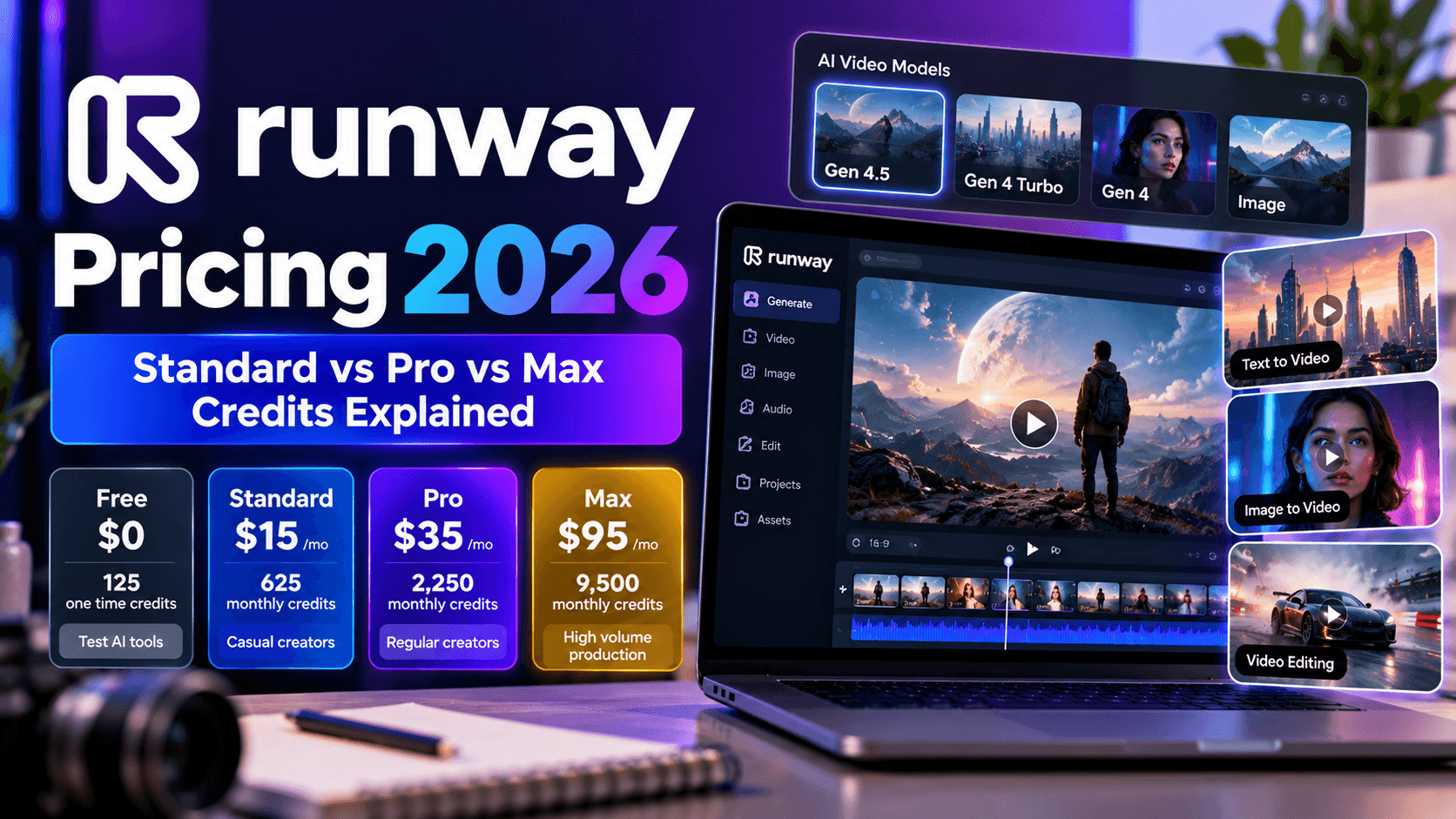
- High quality cinematic video generation using the latest Gen 4.5 models.
Pricing
Runway offers a free Basic plan for users getting started.
Paid subscriptions include Standard at $12 per month, Pro at $28 per month, Unlimited at $66 per month, with Enterprise plans available through custom pricing.
5. Canva Magic Studio + Canva AI 2.0

Few design platforms have expanded as quickly as Canva.
What began as a simple graphic design application has grown into one of the world's most widely used creative platforms for marketers, educators, startups, nonprofits, sales teams, and global enterprises.
Its popularity comes from one simple idea.
Professional looking design should not require years of graphic design experience.
Artificial intelligence has accelerated that vision.
Magic Studio introduced AI assisted design directly inside Canva, allowing users to generate presentations, advertisements, social posts, product visuals, documents, and marketing materials with considerably less manual effort.
Now Canva AI 2.0 is pushing that idea much further.
Rather than offering individual AI features scattered across different menus, Canva is gradually evolving into a conversational creative workspace capable of coordinating several tasks from one request.
That approach aligns closely with the broader movement toward autonomous AI agents.
Users describe what they want to accomplish.
The platform organizes multiple creative steps behind the scenes.
Canva lowers the barrier for creative production
Many businesses simply do not have dedicated design departments.
- Marketing managers.
- Sales representatives.
- Human resources teams.
- Teachers.
- Small business owners.
- Startup founders.
They all produce visual content every week.
Hiring professional designers for every presentation, announcement, advertisement, or social media graphic simply is not practical.
Canva addresses that challenge remarkably well.
Its AI capabilities allow non designers to generate polished creative assets while remaining inside a familiar interface.
That ease of use explains why Canva continues gaining traction among organizations searching for a practical no code AI agent builder experience.
Users rarely need technical knowledge.
They describe their objective.
Canva assembles much of the creative work automatically.
One prompt can trigger multiple creative actions
The upcoming Canva AI experience moves beyond isolated content generation.
Imagine preparing a product launch.
Rather than opening separate tools for writing, designing, resizing, and formatting, you provide one description.
- Canva generates presentation slides.
- Creates matching social media graphics.
- Drafts marketing copy.
- Produces email headers.
- Resizes visuals for different platforms.
- Applies your Brand Kit.
- Prepares everything for editing.
That connected workflow saves significant time for organizations managing multiple campaigns simultaneously.
Creative teams remain free to refine the final output, but much of the repetitive production work has already been completed.
Enterprise collaboration receives equal attention
While Canva remains extremely approachable for beginners, the company has also invested heavily in enterprise collaboration.
- Organizations can maintain Brand Kits.
- Control templates.
- Manage approvals.
- Collaborate across departments.
- Connect workplace tools such as Slack, Google Workspace, and Notion.
That combination makes Canva appealing for both small businesses and large organizations looking to scale creative production without overwhelming centralized design teams.
Best for
Marketing teams, startups, educators, sales organizations, ecommerce businesses, nonprofits, and enterprise companies that want to empower non designers to produce professional creative assets quickly.
Key capabilities
Canva combines accessibility with growing AI automation, making it one of the easiest creative platforms for organizations introducing AI into everyday marketing operations.
Its most valuable capabilities include:
- Magic Design.
- Magic Write.
- Magic Edit.
- Magic Switch.
- Conversational creative workflows.
- Brand Kit management.
- Template governance.
- Content resizing across multiple platforms.
- Connected workplace integrations.
- Collaborative team workspaces.
Pricing
- Canva offers a free plan with limited AI functionality.
- Pro costs approximately €110 per year.
- Business costs approximately €170 per year.
- Enterprise pricing is available through custom plans.
Final Thoughts
AI agents have matured far beyond simple chatbots and isolated content generators.
Today's best AI agents coordinate projects, automate complex workflows, maintain brand consistency, and help creative teams accomplish far more than traditional AI tools ever could.
The right platform depends on your team's priorities.
If your goal is an all in one creative ecosystem with access to leading image, video, voice, and content generation models inside a unified workspace, Pixara.ai stands out as one of the most complete solutions available today.